First off, happy Mom's Day to all you mothers (especially mine).
Secondly, applogies for the sporadic sparceness of late in entries (we had a bit of writer's block after the whole Osama ordeal).
Amy and I just got back from a few days away in Dharamshala, India (specifically the town of Mcleodganj- home of the Dalai Lama). Mcleodganji is a beautiful town buttressed right up against the foothills of the Himalayas. It is a town of Buddhists. Temples. Colorful flags. Monks. And above all: mountains. There is something inherently breathtaking about the place. There is a kind of pull you feel- a calling from the mountains themselves, it would seem.
From our hotel, the valley below us spread out in patchwork brilliance. Behind us, the majestic awe of rock against blue skies, a stark gray painted along the horizon.
Here's a snapshot from my (Katies) journal, sitting on our balcony after a long bus ride to this spiritual hidaway:
"It's raining again. The soft pitter-patter of water on Earth the soundtrack I didn't realize I'd been craving.
The monks on the the street below are draped elegantly in maroon, looking royal and humble simultaneously. They sweep along the tiny alleys- umbrellas in hand.
The mountains are not visible to me here. But, I know they sit squarely behind me. I can feel them, their significance not lost by their absence from my view. I turn and peer around the building, attempt to catch a glimpse of them. They allude me, lure me. I feel a solid grounding, knowing they are there."
I wish we had had more time to let the mountains into our souls. I miss them already. Long to return to them. They have taken a small piece of me. I can only get it back by returning. Can only feel whole in their shadow.
One other tid-bit.
THE bus ride.
I feel like this needs some mention. I find, in perusing my journal, that I have made no note of THE bus ride. Perhaps a subconscious attempt to forget the experience.
Let me set the scene...
Volvo
Diesel engine
No A/C
Personal fans drilled into the walls with a propensity to do nothing more than look pretty
Sweltering heat
Winding, narrow, mountain roads
12hrs
Mosquitoes
Sweat
The jarring bump and jostle of the road beneath our seats tore us in one direction and then another. The squeal of breaks sounding suddenly when least expected forced a slide down the chair until I was more off than on. Wrestling to upright was a laborious and pointless endeavor. And it lasted for hours. And hours. And hours.
We watched the sun fall, a pinky sinking of color, only to wait with cricked necks and numb toes for it to send a gray and murky light into our morning. And all the while the road beneath wore away, the bus swaying sporadically, jerking to stop and start, bouncing with a zeal none of us cared for.
We had a near death experience with what I think was a radical last minute swerve away from a cow (apparently a hit could mean a mob of angry people). The slam left then right then left again left us breathless and with a blood pressure that could have you on metoprolol in no time.
There was also a late night break down (or something like it)- it's hard when you don't know the language and the bus keeps lurching to a stop and dying- crowded around by all sorts of people instructing, what I assume is something along the lines of, "ok, now try going forward." Another lurch and die. "Now try going back." A growl of angry gears, lurch and die. For something like a half hour. Going forward a few feet, only to retreat backwards a few more. Huddled in darkness save the bright headlights.
It was, as Mishty has said, "character building."
MORE TOP MODEL MOMENTS...
Katie's and Amy's adventure of astronomical proportions. Read along as they tempt fate, learn about new and foreign cultures, and explore this vast world for a few months!
08 May 2011
30 April 2011
A Whole New World
Walking up to the Taj Mahal is much like a step into Aladdin's world, where you have to dodge camels, holy cows, rikshaw drivers and people selling their goods. The sun beats down and you bless the hot breeze ruffling your cloth prison.
If you are able to make it through the maze of people and animals to the welcome gates (and security screening), then you are able to observe the magnificent gleaming white mausoleum; the Taj Mahal. If the camels trotting along beside you to the arched entry did not transport you into a different time, the architecture will (as long as you can ignore the cameras sung around every neck).
While never a student of architecture, I can appreciate the beauty and grandeur of one of the seven wonders of the world. The “how” of such buildings boggles my mind. How were people, so long ago, able to build these majestic buildings with rudimentary tools and an army of elephants? I wonder what we leave behind to inspire the future?
To some, the Taj (as I like to call it) may be just a big white marble building, but to the Mughal emperor Shan Jahan it was a mausoleum to his third wife, who died during child birth. Jahan's love and grief for his wife, it is said,were so strong that he felt compelled to commemorate his love her.
Construction began in 1632 and ended in 1648. They were both laid to rest in separate tombs, which sit squarely in the center of the Taj. The size and presence of the building is commendable, but even more stunning is the intricate marble work famed in this area of India. It is called Jali.
The Taj Mahal was constructed using materials from all over India and Asia and over 1,000 elephants were used to transport building materials. In all, twenty eight types of precious and semi-precious stones were inlaid into the white marble (thank you wikipedia).
Enough of the history lets get to the photos where you can see the true beauty!
Sikandra
We spent a brief moment at the Tomb of Akbar the Great the third Mughal emperor.
Fatehpur Sikri
Jaipur nicknamed the pink city (as the old town is still an organized framework of pink on pink)
Amer Fort (where Amy famously lost her new Thai sunglasses while posing for a picture... see previous post)
City Palace
This is a place of kings and queens. In fact, Amy and I managed to be in town the day of a coronation for Japiur's new king. Last week, Maharaja Bhawani Singh passed away. The king had only had a daughter, and she had had a son, who is a 12 year old named Padmanabh Singh. They have no real power, and haven't since the 70's when entitlements were taken away- but it's still fun.
Katie in her first Saree
I think we're turning Japanese, turning Japanese, I really think so!
The most amazing Kebabs in Delhi!! Tundey!!
blah blah blah blah …. travel … blah blah … hot sun, slight breeze, forts, palaces, kings, wifes, architecture, building, meaning, air con, tour guide, religions, no water, naan, dal, Jaipur, Taj Mahal, Mughal history, fans, rikshaws, taxi, tourist, galub jamun, cannons, City Palace, water, camels, locals, hotel, Hindu, more dal, elephants, heat wave, Agra, Sikandra, pistols, fortress, honks. You get the drift. -unitl next time... Amy
If you are able to make it through the maze of people and animals to the welcome gates (and security screening), then you are able to observe the magnificent gleaming white mausoleum; the Taj Mahal. If the camels trotting along beside you to the arched entry did not transport you into a different time, the architecture will (as long as you can ignore the cameras sung around every neck).
While never a student of architecture, I can appreciate the beauty and grandeur of one of the seven wonders of the world. The “how” of such buildings boggles my mind. How were people, so long ago, able to build these majestic buildings with rudimentary tools and an army of elephants? I wonder what we leave behind to inspire the future?
To some, the Taj (as I like to call it) may be just a big white marble building, but to the Mughal emperor Shan Jahan it was a mausoleum to his third wife, who died during child birth. Jahan's love and grief for his wife, it is said,were so strong that he felt compelled to commemorate his love her.
Construction began in 1632 and ended in 1648. They were both laid to rest in separate tombs, which sit squarely in the center of the Taj. The size and presence of the building is commendable, but even more stunning is the intricate marble work famed in this area of India. It is called Jali.
The Taj Mahal was constructed using materials from all over India and Asia and over 1,000 elephants were used to transport building materials. In all, twenty eight types of precious and semi-precious stones were inlaid into the white marble (thank you wikipedia).
Enough of the history lets get to the photos where you can see the true beauty!
Sikandra
We spent a brief moment at the Tomb of Akbar the Great the third Mughal emperor.
Fatehpur Sikri
Jaipur nicknamed the pink city (as the old town is still an organized framework of pink on pink)
Amer Fort (where Amy famously lost her new Thai sunglasses while posing for a picture... see previous post)
City Palace
This is a place of kings and queens. In fact, Amy and I managed to be in town the day of a coronation for Japiur's new king. Last week, Maharaja Bhawani Singh passed away. The king had only had a daughter, and she had had a son, who is a 12 year old named Padmanabh Singh. They have no real power, and haven't since the 70's when entitlements were taken away- but it's still fun.
Katie in her first Saree
I think we're turning Japanese, turning Japanese, I really think so!
The most amazing Kebabs in Delhi!! Tundey!!
blah blah blah blah …. travel … blah blah … hot sun, slight breeze, forts, palaces, kings, wifes, architecture, building, meaning, air con, tour guide, religions, no water, naan, dal, Jaipur, Taj Mahal, Mughal history, fans, rikshaws, taxi, tourist, galub jamun, cannons, City Palace, water, camels, locals, hotel, Hindu, more dal, elephants, heat wave, Agra, Sikandra, pistols, fortress, honks. You get the drift. -unitl next time... Amy
28 April 2011
And I Still Got Love for the Street
TRAFFIC
“Do you think you can drive here?” seems to be the question on everyone's lips.
I say a silent prayer to every God I've been introduced to along this journey when I pull the car door shut behind me and settle into the tiny aluminum cans that fill these streets with a kind of rapt excitement; 2 parts dread, 1 part thrill.
The streets of India are a kind of alternate universe. In this universe there are an entirely different set of laws and cultures. A camel trots along the edge of the road- trailing an oversided cart in its wake. An elephant plods toward us, it's ears waving frantically to cool its face.
I could spend a lifetime trying to comprehend the language of beeps and squawks that fill the air. I can hear them now in my hotel room above the road. Beep. Beep. Beeeeep. Squawk. Chime-didily-chime-chime (some kind hiccuping duck- sorry UO fans). The big rigs are the strangest- they emit a sing-song-y tune that is so silly coming from such a large vehicle (reminding me of an ice-cream truck in summer).
Sense of sound is some much more relied upon here than sight. In fact, many drivers choose to tuck their mirrors up against their cars to prevent them being ripped off by a close encounter. They drive half blind and use this secret horn language to avoid collision.
Vehicles, for the most part, drive on the left side of the road. This, however, appears to be optional. Traffic lights also appear to be optional (especially for rickshaws and cyclists). There is a weaving and dodging pattern to the flow. A jerk forward to a slam of a stop, barely missing the back tire of a motorbike slipping in front of us.
It's like a video game- for reals yo. Terrifyingly delightful. The redeeming quality, the fact that, because of traffic, vehicles are not able to exceed more than about 30 mph (at best).
My other favorite thing about traffic here: the art work I'm surrounded by as I journey along. The truck drivers here take a certain pride in their forest green trucks, decorating them with hand made paintings, and draping their mirrors and dashboards with idols and flowers. Sometimes the calligraphied instructions on the back, advising other drivers to, “Stop. Honk Please. Stop” is spelled particularly creatively, and occasionally the classic painting of a cow her calf often actually depicts a bull with udders.
To answer their common question: NO, I don't think I could drive here.
OLD TOWN
Yesterday we adventured into “old” Delhi", a title earned by impressive relativity, as everywhere in Delhi is old (in fact, the area known as “New” Delhi was built by the British in 1931, a monumental new quarter of the city designed by the British architect Edwin Lutyens to house the government buildings).
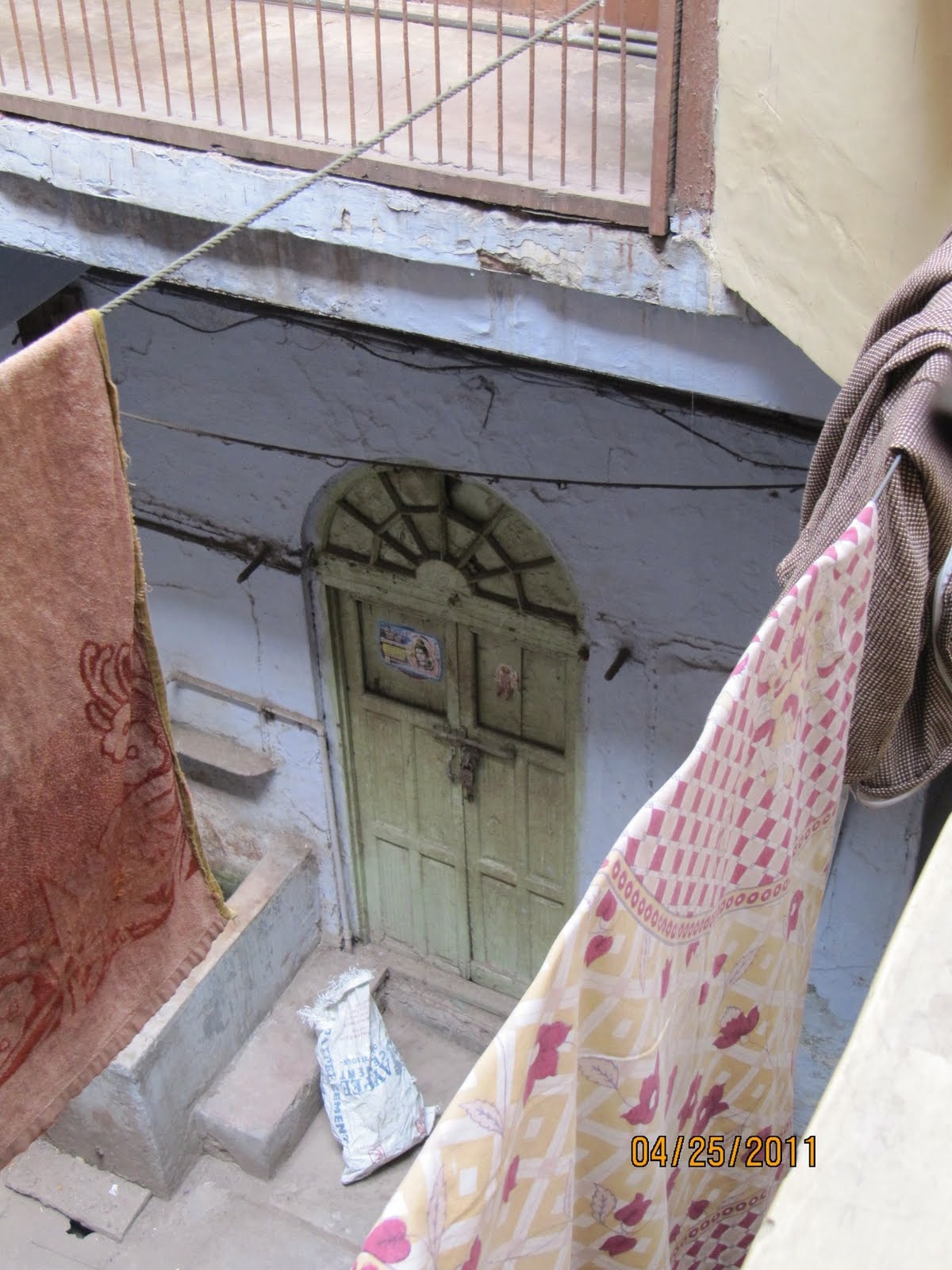
The buildings in Old Delhi a made of a hodge-podge collection of materials. The bottom level is filled with shops selling specialty items- with alleys dedicated specifically to shoes, or books, or jewelry. The upper stories are less solid appearing, with corners crumbling, falling away from themselves. Laundry on lines strung between windows hangs heavy above our heads.
The disrepair of the second, third, sixth stories are quiet; a series of ruins connected to one another in crisscrossing patterns- a piece of yesterday floating eerily above us. The cracks and chips give the building character, personality, wisdom.
Below, the incessant clamor and bustle breathes a life of its own. The street level of Chandni Chowk is a throbbing, vibrant, pulsating organ. The push of pedestrians, rickshaws, motorbikes, cyclists, cars, and carts swarm around us- seeming to feed off the heat swelters and invades every nook and cranny. They brush against one another lacking order and structure. There are no rules in this piece of the world.
Our rickshaw thumps and careens through the solid wall of people. We squash together in the old space, surrounded by brightly colored ribbons, sequence, lays sold exclusively on this unnamed (as far as I can see) alleyway. This street is an inlet of a larger alley, selling only shoes.
As we jut down the alleyways the stares come in twos and threes. A wide eyed, unembarrassed gawk that lingers as we pass. White, here, is exotic. I see their eyes snapping pictures of my alabaster-ness as they slump against a wall, sit heavily on a stoop or wonder past in the other direction. They do not care that I see them seeing me. They smile and sometimes wave. A novelty.
These ancient paths- no more wide in places than the rickshaw jarring me in one direction and then the other- come together and apart. These paths are the veins of the city, bringing life and warmth to the shops and restaurants. The blood flow in these tiny capillaries is unbelievable. I fear they should burst and hemorrhage a hot bath of city in every direction. I love it.
Here's some shots from our trip to Old Town. And a sneak peak at the stuff for our next blog. Stay tuned.
“Do you think you can drive here?” seems to be the question on everyone's lips.
I say a silent prayer to every God I've been introduced to along this journey when I pull the car door shut behind me and settle into the tiny aluminum cans that fill these streets with a kind of rapt excitement; 2 parts dread, 1 part thrill.
The streets of India are a kind of alternate universe. In this universe there are an entirely different set of laws and cultures. A camel trots along the edge of the road- trailing an oversided cart in its wake. An elephant plods toward us, it's ears waving frantically to cool its face.
I could spend a lifetime trying to comprehend the language of beeps and squawks that fill the air. I can hear them now in my hotel room above the road. Beep. Beep. Beeeeep. Squawk. Chime-didily-chime-chime (some kind hiccuping duck- sorry UO fans). The big rigs are the strangest- they emit a sing-song-y tune that is so silly coming from such a large vehicle (reminding me of an ice-cream truck in summer).
Sense of sound is some much more relied upon here than sight. In fact, many drivers choose to tuck their mirrors up against their cars to prevent them being ripped off by a close encounter. They drive half blind and use this secret horn language to avoid collision.
Vehicles, for the most part, drive on the left side of the road. This, however, appears to be optional. Traffic lights also appear to be optional (especially for rickshaws and cyclists). There is a weaving and dodging pattern to the flow. A jerk forward to a slam of a stop, barely missing the back tire of a motorbike slipping in front of us.
It's like a video game- for reals yo. Terrifyingly delightful. The redeeming quality, the fact that, because of traffic, vehicles are not able to exceed more than about 30 mph (at best).
My other favorite thing about traffic here: the art work I'm surrounded by as I journey along. The truck drivers here take a certain pride in their forest green trucks, decorating them with hand made paintings, and draping their mirrors and dashboards with idols and flowers. Sometimes the calligraphied instructions on the back, advising other drivers to, “Stop. Honk Please. Stop” is spelled particularly creatively, and occasionally the classic painting of a cow her calf often actually depicts a bull with udders.
To answer their common question: NO, I don't think I could drive here.
OLD TOWN
Yesterday we adventured into “old” Delhi", a title earned by impressive relativity, as everywhere in Delhi is old (in fact, the area known as “New” Delhi was built by the British in 1931, a monumental new quarter of the city designed by the British architect Edwin Lutyens to house the government buildings).
The buildings in Old Delhi a made of a hodge-podge collection of materials. The bottom level is filled with shops selling specialty items- with alleys dedicated specifically to shoes, or books, or jewelry. The upper stories are less solid appearing, with corners crumbling, falling away from themselves. Laundry on lines strung between windows hangs heavy above our heads.
The disrepair of the second, third, sixth stories are quiet; a series of ruins connected to one another in crisscrossing patterns- a piece of yesterday floating eerily above us. The cracks and chips give the building character, personality, wisdom.
Below, the incessant clamor and bustle breathes a life of its own. The street level of Chandni Chowk is a throbbing, vibrant, pulsating organ. The push of pedestrians, rickshaws, motorbikes, cyclists, cars, and carts swarm around us- seeming to feed off the heat swelters and invades every nook and cranny. They brush against one another lacking order and structure. There are no rules in this piece of the world.
Our rickshaw thumps and careens through the solid wall of people. We squash together in the old space, surrounded by brightly colored ribbons, sequence, lays sold exclusively on this unnamed (as far as I can see) alleyway. This street is an inlet of a larger alley, selling only shoes.
As we jut down the alleyways the stares come in twos and threes. A wide eyed, unembarrassed gawk that lingers as we pass. White, here, is exotic. I see their eyes snapping pictures of my alabaster-ness as they slump against a wall, sit heavily on a stoop or wonder past in the other direction. They do not care that I see them seeing me. They smile and sometimes wave. A novelty.
These ancient paths- no more wide in places than the rickshaw jarring me in one direction and then the other- come together and apart. These paths are the veins of the city, bringing life and warmth to the shops and restaurants. The blood flow in these tiny capillaries is unbelievable. I fear they should burst and hemorrhage a hot bath of city in every direction. I love it.
Here's some shots from our trip to Old Town. And a sneak peak at the stuff for our next blog. Stay tuned.
Subscribe to:
Posts (Atom)